Pietro
The Eight Mountains: A NovelPietro is the narrator whose movement between city and mountain becomes a way of measuring what he knows about himself and his family. As a child, he sees his father’s delight in studying routes and learns that the mountains are not merely scenery but a world he must experience to understand. As an adult, he returns to that world through his friendship with Bruno and the work of rebuilding a ruin inherited from his father. Maps, a summit notebook, and a memorial carved into rock gradually give material form to a relationship Pietro had once experienced as distant and divided.
Identity and Early Formation
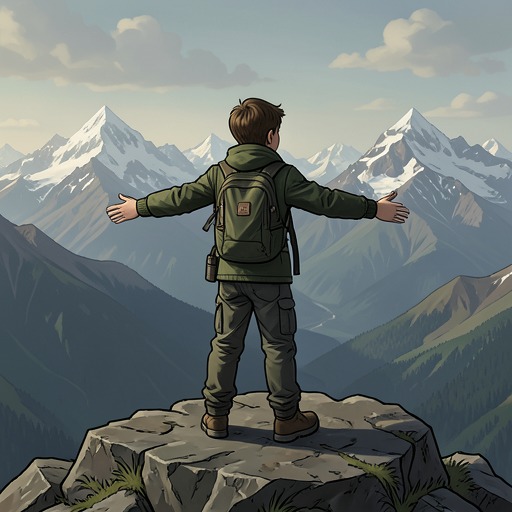
In the city, Pietro knows his father as a reserved presence, but in Grana mountain village he sees a different man. His father unfolds a map after supper, points out streams, lakes, huts, forests, meadows, scree, glaciers, contour lines, and summits, and explains that the party descends only when it can climb no farther. Pietro cannot yet understand the map as his father does. What he recognizes instead is the joy the mountains awaken in him, a joy strong enough to make Pietro want to see that world for himself.
Years later, his father recalls a moment that he treats as the beginning of Pietro’s vocation. One morning, while his mother still slept, he looked up from lacing his boots and found Pietro already dressed and ready to follow him. The child was six or seven and, in his father’s telling, looked uncannily like the adult he would become. His father remembered Pietro saying, “I want to come with you,” though the adult narrator allows that this may have been only the phrase his father liked to remember. The difference between the remembered scene and the uncertainty around its exact words establishes a recurring feature of Pietro’s story: his understanding of the past comes through other people’s recollections as well as his own.
As a boy, Pietro spends the colder months in Milan and longs for the return to Grana. The city’s winter light and traffic make the mountain summer seem almost unreal, until signs of spring turn nostalgia into anticipation. Bruno, meanwhile, stays in the village and waits for Pietro’s family to come back. On their arrival he calls Pietro by the nickname Berio, which he gave him as a child, and takes him off to have adventures. The intervening months seem to vanish; their friendship resumes as if it had been one uninterrupted summer. Bruno is already growing up faster, often dirtied by work in the stables and unwilling to come indoors, while Pietro is still closely associated with books and the city.
The Inheritance and His Father’s Mountain Map
After his father’s funeral, Pietro returns to Milan and stays with his mother. In his father’s desk he finds practical instructions, bank details, and arrangements for the family inheritance. The paper leaves his mother her half of their Milan apartment and names the property in Grana for Pietro, without a farewell or explanation. His mother knows little about the mountain purchase: his father had acquired a small piece of land the previous year without asking her permission or inviting her to see it. Their later lives, Pietro discovers, had become more separate than he had assumed. His mother had retired, volunteered as a nurse at a clinic for immigrants, and spent much of her time with friends, while his father worked and travelled.
At the old house, the objects left behind make the inheritance feel less like a legal transfer than a set of clues. His father’s flavored grappa remains in the kitchen, where Pietro warms himself beside the stove. His mother’s domestic touch is still visible in the copper pans, wooden spoons, dried flowers, radio, and a photograph of Pietro and Bruno sitting back to back on a larch stump. The photograph’s matching clothes and deliberately tough pose make the boys look like brothers. Above these intimate traces hangs his father’s map, still thumbtacked to the wall but transformed by years of use.
The map no longer serves simply to show the valley’s trails. After two decades, routes reach nearly every summit, alpine pasture, and refuge, their accumulated lines dense enough to make the map illegible to anyone else. Pietro notices black, red, and green markings and tries to work out their code as if solving one of the riddles his father used to set him. The three-color routes recall an occasion when Pietro, his father, and Bruno became stuck together on a glacier. Red and green stop at the point where the black route continues, allowing Pietro to infer that his father finished the climb alone on another occasion. Black is his father, red is Pietro, and green is Bruno. The many routes marked in black and green stir jealousy, but also relief that his father had not spent all those years in the mountains alone. Pietro begins to read the map as a message left for him, though its meaning is made of paths rather than words.
Rebuilding and Remembering
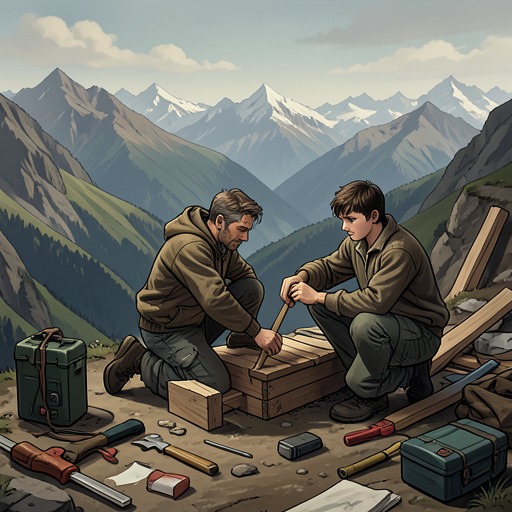
When Bruno asks Pietro to help with the ruins, Pietro is sitting on a wall in the snow above a frozen lake, at an altitude of two thousand meters. Bruno explains that a laborer would help him finish in three or four months. Pietro recognizes that on the plains he would have dismissed the proposal, but here he feels drawn into the work by a connection he cannot yet explain: his father had wanted him to come to this clearing, beneath the strange rock, and work with Bruno. He accepts the task as another of his father’s riddles and a chance to learn what the inheritance means.
A conversation with his mother changes the way he understands that inheritance. Remembering his father’s reflections on glaciers, Pietro sees that he had lived with two versions of the same man: the stranger of the city, from whom he had been estranged, and the mountain-going father he had glimpsed on paths and beside glaciers. His father had described a glacier as the snow of winters long past, preserving what summer melts away. Pietro applies that image to memory and decides to complete the work as a way of remembering the father he had only belatedly come to know.
The building’s details turn that decision into shared, durable labor. By August, Pietro and Bruno have finished the roof: larch shingles over planks, a metal sheet, and insulation, with spruce matchboards inside. They omit a skylight so that the interior will remain shaded even in summer. The north-facing windows look across the lake toward the mountains, whose light enters as if reflected from a mirror. The house is practical shelter, but its construction also gives Pietro and Bruno a common undertaking where their separate histories meet.
On the last day of the visit, Pietro brings his mother up from Grana. She climbs for two hours in the leather boots she has worn since Pietro was a child, keeping a slow, sure pace without stopping. In the finished house, Bruno lights the stove and the three drink tea. Pietro’s mother looks through the window, then goes outside to take in the lake, scree, peaks of Grenon, and the house as if fixing them in memory. The day before, Pietro had carved his father’s name and dates into the rock wall and painted the letters black. Beneath them he inscribed, “IN MEMORY IS THE MOST BEAUTIFUL REFUGE.” His mother calls for the song sung when a lover of the mountains dies, asking God to let him continue walking in the afterlife; both Pietro and Bruno know it.
Pietro then makes explicit what the joint work has already established: the house is not to be his alone, but a home belonging equally to him and Bruno. He believes this is what his father wanted, but insists that he wants it for himself because the two friends built the place together. Bruno asks whether he is sure. The offer makes the inheritance something other than a private possession: Pietro turns what his father left him into a bond he chooses to share.
The Mountains as a Record of Friendship
Pietro’s later encounters with the mountains keep revising what he thinks he knows about both his father and Bruno. On a barren summit above his house, he finds a metal box holding a notebook in a plastic bag. Its pages have been damp, and only a small number of climbers reach the mountain each year. Pietro recognizes his father’s handwriting in a 1997 entry: “Climbed up from Grana in 3 hours and 58 minutes. Still in great shape! Giovanni Guasti.” The time and cheerful exclamation mark make the absent man present through his own small, public record. Pietro imagines him hurrying over the scree to finish in under four hours, then decides that removing the page would be as wrong as taking a stone from the summit.
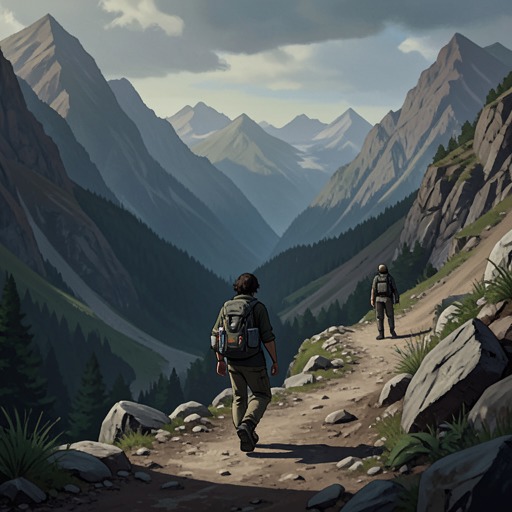
In 2008, climbing Grenon with Bruno through thick fog, Pietro briefly imagines recording a first ascent on the mountain’s north-west crest under his own name. Rusty tins on a ledge quickly show that someone has preceded him. Bruno takes a steeper line, climbing rapidly on all fours, choosing hand- and footholds by instinct. Pietro watches this unfamiliar technique from the crest and thinks of Omo servadzo, the wild man. The episode brings out their differences without undoing their closeness: Pietro is alert to routes and records, while Bruno moves through the terrain with a physical fluency that is his own.
The mountain also gives Pietro a place to tell Bruno about his plans to leave again. He has secured enough funding in Milan to spend at least a year in Nepal, where he wants to portray the people who live in the Himalayan valleys. He has little money but contacts who can help and provide lodging. He has given up his home in Turin and does not want another; if the work goes well, he may stay in Nepal longer. An old man carrying live chickens below Everest tells Pietro that he is making the tour of the eight mountains, after Pietro explains how attachment to the mountain where he grew up led him to seek out the world’s beautiful mountains. His journeys outward are thus connected, in his own account, to the mountain that first formed his desire to travel.
Much later, while he and Bruno carry cheese down from the pasture, the childhood road returns as a measure of what has changed and what has endured. Bruno recalls coming up from Grana each day in August and leaving the pasture to go off with Pietro, despite being beaten by his uncle afterward. Now they are carrying Bruno’s cheese along that same route. Their work, ages, and circumstances have altered, but the road still joins them to the boys they were.
Departure and the Unfinished Rescue
In the final winter scenes, Pietro’s impulse to leave is no longer a simple return to the city or a journey abroad. On a clear morning after prolonged snowfall, a helicopter passes above the two men without noticing them. Snow begins sliding from Grenon’s overhangs in small avalanches. Nearby, the ski slopes on Monte Rosa are busy on a perfect day for skiing, while Pietro and Bruno stand in the shadow of a ridge beside a landslide and dead fish. The contrast places their predicament outside the bright, functioning world below.
Pietro says he is going, acknowledging that twice in a few weeks he has tried and failed to rescue Bruno. Bruno agrees that leaving seems right, and Pietro urges him to come down too. The passage does not resolve the separation or explain what will happen to Bruno; it ends with Pietro’s renewed attempt to depart and the friend’s response. Across the story, Pietro has repeatedly come and gone while Bruno stays in the mountains. Here that contrast becomes urgent rather than seasonal. The character who once followed his father uphill, then returned to rebuild with Bruno, faces the limits of what loyalty and shared memory can accomplish. His life remains shaped by departure, but the places and people he leaves behind continue to call him back.